
Classes
Toronto Aikikai offers classes for children, youth and adults. Dojo members may take as many classes as they wish in their membership category, regardless of experience or skill level. Prospective new members may observe any of the classes and are welcome to try out an Aikido or Iaido class without charge or obligation. Visiting members from other dojos or affiliations are welcome to drop in and practice with us.

We have classes 7 days a week, from Monday to Friday in the evening and on Saturday and Sunday in the morning and early afternoon. Starting in 2017 the class schedule is as follows:
| MONDAY | TUESDAY | WEDNESDAY | THURSDAY | FRIDAY | SATURDAY | SUNDAY |
| IAIDO Adults 9:30-10:30 | | |||||
| WEAPONS Adults 10:45-12:00 | AIKIDO Chdn & Yth 10:30-11:20 | |||||
| AIKIDO Adults 12:15-1:15 | AIKIDO Adults 11:30-12:30 | |||||
| AIKIDO Children 5:00-5:50 | IAIDO Adults 5:30-6:20 | AIKIDO Children 5:00-5:50 | IAIDO Adults 5:30-6:20 | |||
| AIKIDO Youth 6:00-6:50 | WEAPONS Adults 6:30-7:20 | AIKIDO Youth 6:00-6:50 | AIKIDO Adults 6:30-7:20 | AIKIDO Adults & Yth 6:00-7:00 | ||
| AIKIDO Adults 7:00-8:15 | AIKIDO Adults 7:30-8:30 | AIKIDO Adults 7:00-8:15 | AIKIDO Adults 7:30-8:30 |
Our Children classes are closely aligned with the school year and take place in three terms: the first one from early January to late March, the second one from early April to late June and the third one from early September to mid December. In these classes we emphasize safety, cooperation and simple Aikido. Classes are taught in a disciplined yet fun setting, and include stretching, rolling, basic techniques and games. These classes are open to children starting at age 5 and to their parents, and provide children with benefits in the following areas:
These are some frequently asked questions about our Children classes: | |||||||||||||||||||||||||||||||||||||||||
The Youth classes provide focused and dedicated instruction for teenagers with or without previous experience as well as for pre-teenagers and our younger members who have outgrown the Children classes. The instruction emphasizes respectful and cooperative practice, building a solid foundation of Aikido techniques and self-defence skills, and developing stamina, flexibility, self-confidence, and concentration. These classes approach Aikido's technical aspects and philosophy at introductory to intermediate levels, including basic handling of the Jo (wooden staff) and the Bokken (wooden sword), and serve as a bridge for continuing to adult level classes. | |||||||||||||||||||||||||||||||||||||||||
Adult Aikido classes focus on the development of the essential skills required for the safe and correct practice of Aikido. Techniques and principles are presented emphasizing the fundamental concepts and techniques of Aikido, including proper etiquette, footwork, body movement, positioning, falling (ukemi), the use of momentum and the development of a strong and stable center. As the practitoner acquires experience, he or she progresses through Beginner, Intermediate and Advanced levels. 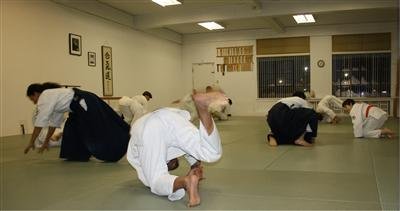 Beginner Level -
Beginners are introduced to the basic concepts and techniques of Aikido including
proper etiquette, footwork, body movement, positioning, falling (ukemi) and basic techniques.
A senior student is assigned to practice with beginners until they have developed sufficient skills to safely train on their own.
Beginner Level -
Beginners are introduced to the basic concepts and techniques of Aikido including
proper etiquette, footwork, body movement, positioning, falling (ukemi) and basic techniques.
A senior student is assigned to practice with beginners until they have developed sufficient skills to safely train on their own.
 Intermediate Level -
As Beginners progress they reach the Intermediate Level and now their practice emphasizes
the use of momentum and the development of a strong and stable center.
Fundamental and applied techniques are practiced at this level, reinforcing the materials covered in the Beginner Level.
The focus is on the development of supple ukemi, increased stamina, flexibility and practical application.
The technical content and pace of practice at the Intermediate Level is more demanding than at Beginner Level.
Intermediate Level -
As Beginners progress they reach the Intermediate Level and now their practice emphasizes
the use of momentum and the development of a strong and stable center.
Fundamental and applied techniques are practiced at this level, reinforcing the materials covered in the Beginner Level.
The focus is on the development of supple ukemi, increased stamina, flexibility and practical application.
The technical content and pace of practice at the Intermediate Level is more demanding than at Beginner Level.
 Advanced Level -
Once Advanced Level is attained the focus of practice changes to advanced techniques, preparing the student
for testing for higher ranks and for real life situations. The pace and intensity of Advanced Level classes is more demanding
than all other classes, and attendance is open only to adult dojo members who have developed the required stamina
and have attained a high degree of skill in the art of ukemi.
Advanced Level -
Once Advanced Level is attained the focus of practice changes to advanced techniques, preparing the student
for testing for higher ranks and for real life situations. The pace and intensity of Advanced Level classes is more demanding
than all other classes, and attendance is open only to adult dojo members who have developed the required stamina
and have attained a high degree of skill in the art of ukemi.
These classes are open to all adult members of the dojo regardless of rank or experience, however attendance to specific classes will better suit the skill level attained, as suggested in the table above. | |||||||||||||||||||||||||||||||||||||||||
Although a study in itself, weapons training is part of the Aikido curriculum, and is synergystic with the practice of body arts. Weapons practice helps in the development of balance, posture, movement, hand to eye coordination and concentration. We practice with Bokken (wooden sword), Jo (wooden staff) and Tanto (wooden knife). Attendance to these classes is open to all adult dojo members, regardless of rank. | |||||||||||||||||||||||||||||||||||||||||
Iaido (pronounced: ee-eye-doe) is the traditional art of drawing, cutting and resheathing the Japanese sword. It is a practice separate from, but complementary to, Aikido. Each class is divided into two parts: warmups, consisting of the practice of basic movements, and kata, the practice of set forms, which are performed from either seated or standing positions. Iaido classes do not involve contact with another practitioner. | |||||||||||||||||||||||||||||||||||||||||
| |||||||||||||||||||||||||||||||||||||||||


© Toronto Aikikai - 58 Ritchie Avenue, Toronto, ON, M6R 2J9, (416) 531-8273, info@torontoaikikai.com